Why Your Water Heater Is Making That Noise (And What to Do)
Popping. Rumbling. Banging. Hissing. Ticking. Every sound your water heater makes is the unit trying to tell you something specific — and most of those sounds fall into six categories with well-understood causes. Here's how to decode them, which ones mean "call today," and the one maintenance habit that prevents 80% of the noise we see on service calls.
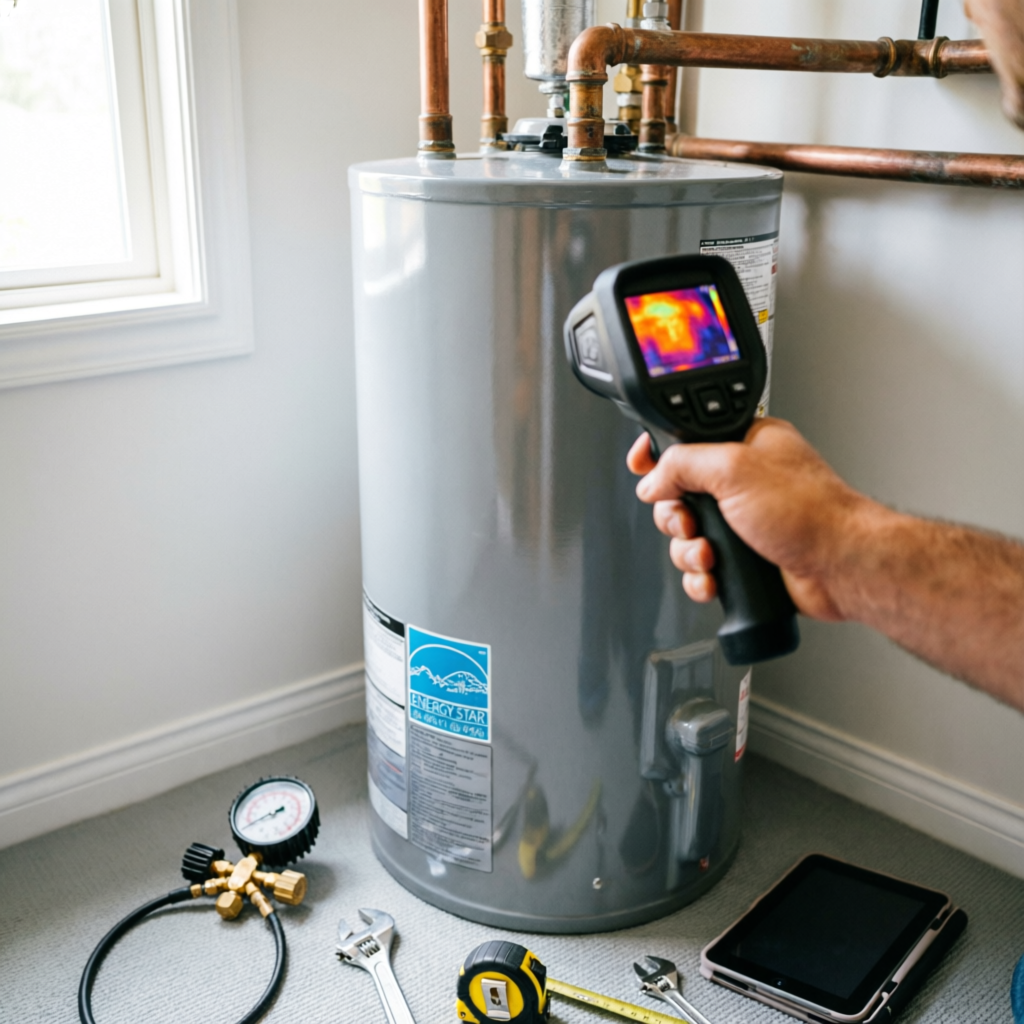
A healthy water heater is a quiet water heater. You should barely notice it running — a faint whoosh of the burner firing, maybe a soft hum from the gas valve, and that's it. When your unit starts making noise you can hear from the kitchen, it's telling you something is wrong with how it's operating. Not necessarily something catastrophic, but something that, left alone, will shorten its life by years.
After 12 years leading water heater service across Los Angeles and San Diego, I've learned that the specific sound the unit is making tells me — with about 85% accuracy — what's wrong before I even open the access panel. Popping means sediment. Hsing means a leak on the burner. Screaming means a pressure issue. Each sound has a specific cause and a specific fix.
Popping and rumbling (the most common)
What it sounds like: Popcorn popping inside the tank. Low, dull rumbling when the burner fires. Occasional sharp "pops" that you can hear from the next room.
What's happening: This is the single most common water heater sound we hear on service calls, and it almost always means one thing — sediment buildup at the bottom of the tank. Over years of heating water, dissolved minerals (calcium, magnesium, silica) settle out and accumulate on the tank floor. In San Diego's 280–340 ppm hard water, a tank can build up 1–2 inches of sediment in just 3–4 years without flushing.
When the burner fires, the sediment layer insulates the water above it from the heat. The steel tank bottom directly above the burner overheats — sometimes to 400°F+ — while the water a few inches above stays at 120°F. Water trapped in small pockets under and within the sediment layer flashes to steam, expands rapidly, and bursts through the sediment. That's the "pop" you hear.
Severity: Moderate — not an emergency, but address within 2 weeks. Popping alone won't cause an immediate failure, but it's accelerating wear on the tank. Overheated steel becomes brittle and prone to cracking. A tank that's been popping for years is a tank that will fail sooner than its rated lifespan.
The fix: A professional tank flush clears most sediment. If the tank is over 8 years old and has been popping for months, the steel has likely already been heat-damaged — replacement is often the smarter investment than a flush. We'll tell you honestly on the diagnostic visit which makes more sense.
Banging and knocking (water hammer)
What it sounds like: A sharp "bang" or series of knocks in the pipes immediately after you shut off a faucet, toilet, dishwasher, or washing machine. Often loud enough to rattle walls.
What's happening: This is water hammer — a hydraulic shock wave that travels through your plumbing when moving water is suddenly stopped. The water column slams into the closed valve, creating a pressure spike that can reach 300+ PSI for a fraction of a second. The pipes shake, joints flex, and you hear the bang.
Water hammer isn't strictly a water heater problem — it's a whole-house plumbing issue — but it often shows up loudest near the water heater because that's where long pipe runs terminate. Repeated water hammer stresses every fitting in your home and is a common cause of pinhole leaks in copper supply lines, particularly in La Jolla and Coronado where SD's hard water has already weakened pipe walls.
Severity: Moderate — address within a month, sooner if frequent. Occasional mild hammer is common in older homes. Daily hammer on every fixture shutoff is actively damaging your plumbing.
The fix: Install water hammer arrestors at the offending fixtures. If the issue is whole-house, a pressure-reducing valve at the main or air chambers at the water heater and longest branch lines solves it. We check for water hammer on every service call — it's often the root cause of leaks we're called to fix.
Hissing and sizzling
What it sounds like: A steady hissing or sizzling sound from inside the water heater cabinet, often accompanied by a smell of hot metal or, on gas units, a slight change in burner flame color.
What's happening: This is almost always a small leak dripping onto the burner or hot tank surface. The water vaporizes on contact, producing the hissing sound. On gas units, the leak may be from the tank itself, from the cold water inlet fitting, from the temperature-and-pressure (T&P) relief valve discharge pipe, or from the anode rod port. On electric units, the leak may be reaching the lower heating element.
Severity: High — call same day. A leaking water heater is a leaking water heater, regardless of whether the leak is currently small. Leaks don't self-heal and they don't get smaller. A quarter-sized drip today is a full-flow rupture next week — and 85% of catastrophic water heater failures in our service history started as "just a hiss."
The fix: A licensed technician needs to identify the leak source. If it's a fitting or the T&P valve, repair. If the leak is from the tank itself, replacement is the only option — tanks cannot be patched. Turn off the cold water inlet and the gas valve (or electric breaker) while waiting for service.
If the hissing is accompanied by any gas smell, leave the house immediately. Don't flip switches, don't use your phone inside. Call 911 from outside, then the gas company. See our emergency signs guide for the full protocol.
Ticking and clicking
What it sounds like: Regular, quiet ticking or clicking — often rhythmic, like a clock — that starts when the burner fires and continues for a few minutes. Sometimes localized to a specific point near the top or bottom fittings.
What's happening: Ticking is usually thermal expansion and contraction of metal components. As the tank heats up, the steel expands; as it cools, it contracts. The ticking is the metal moving against pipe hangers, mounting straps, or the heat-trap nipples at the inlet and outlet fittings.
Heat-trap nipples (standard on all water heaters made after 2010) have internal flappers or balls that prevent convective heat loss up the pipes. As water flow starts and stops, these components can click softly — perfectly normal.
Severity: Low — usually normal operation. Mild ticking is expected on modern water heaters and doesn't indicate a problem. Loud, irregular ticking or ticking accompanied by visible movement of pipes means the pipes are poorly secured and need additional hangers.
The fix: For normal ticking, no fix is needed. For loud ticking from loose pipes, a technician can add pipe hangers and foam insulation to quiet it down.
Humming and whining (electric units)
What it sounds like: A low, steady hum or whine from an electric water heater when the elements are energized. Often more noticeable at night when the house is quiet.
What's happening: Electric water heaters use high-wattage (4,500W) resistance elements that can vibrate at 60 Hz in the magnetic field they generate. Mild hum is normal, particularly on newer high-efficiency elements. A loud or increasing hum typically means the element is loosening in its mounting, has developed scale deposits that unbalance it, or the voltage is higher than the element's rating (common in Pasadena and Glendale where LADWP voltage can run hot).
Severity: Low to moderate. Mild hum is normal. Loud, new, or increasing hum should be diagnosed within a month — a vibrating element can eventually work loose and create an electrical fault.
The fix: A technician can tighten the element mounting, descale the element, or replace it. If the voltage is consistently over 245V, an electrician should install a voltage regulator — that's a separate call from the plumber.
Screaming or screeching from the T&P relief valve
What it sounds like: A high-pitched scream or screech from the temperature-and-pressure relief valve on the side or top of the tank. Often accompanied by steam or hot water discharge from the valve's discharge pipe.
What's happening: The T&P valve is a critical safety device that opens when tank pressure exceeds 150 PSI or temperature exceeds 210°F. A screaming valve means the tank is over-pressure or over-temperature — most commonly caused by a failed pressure-reducing valve on the main, a closed thermal expansion tank, or a stuck thermostat letting the burner overheat the water.
Severity: Critical — call now. A tank that's exceeding T&P relief thresholds is under extreme stress. Tank ruptures from over-pressure are rare but catastrophic — when they happen, the tank can literally explode with the force of a small bomb, destroying walls, ceilings, and causing serious injury. This is the one water heater sound that should never wait.
The fix: Turn off the water heater immediately (gas valve to "off," electric breaker off). Call for same-day service. The technician will test the incoming water pressure, inspect the T&P valve, check the expansion tank, and verify the thermostat.
The annual flush that prevents 80% of noise
If there's one takeaway from this guide, it's this: an annual professional tank flush eliminates or prevents most water heater noise. Sediment is the root cause of popping, rumbling, reduced efficiency, and accelerated tank wear. Removing it once a year keeps the tank quiet, efficient, and running to its full rated lifespan.
What a professional flush includes
Our flush service isn't just "drain and refill." It includes:
- Full drain of the tank with high-flow hose to evacuate sediment
- Cold-water back-flush to stir and remove settled scale
- Anode rod inspection and thickness measurement (the rod that protects the tank from rust — usually needs replacement every 3–5 years)
- T&P relief valve lift test to confirm it opens at the correct pressure
- Burner and flame inspection (on gas units) for proper combustion
- Thermostat calibration check
- Visual inspection of all fittings, valves, and the drain pan
- Written report documenting the condition of each component
The SD hard-water caveat
In San Diego's 280–340 ppm hard water, annual flushing is especially critical. We see tank water heaters in SD last 6–9 years on average vs. 8–12 years in softer water regions. A homeowner who skips flushing for 3+ years in SD almost always needs a full replacement earlier than expected. Our full San Diego hard water guide breaks down the chemistry in detail.
For tankless water heaters, the equivalent maintenance is an annual descaling flush — required by every major manufacturer (Navien, Rinnai, Noritz). Skipping descaling in SD water can destroy a tankless heat exchanger in under 2 years. Our tankless vs. tank comparison covers the maintenance differences.
Frequently asked questions
Popping itself isn't immediately dangerous, but it signals sediment buildup that's actively shortening your tank's life. The sediment insulates the water from the burner, causing the steel tank bottom to overheat locally — sometimes to 400°F+. Over time, this overheated steel becomes brittle and prone to cracking, which can lead to a tank rupture. We recommend a professional flush within two weeks of hearing regular popping. If the tank is over 8 years old and has been popping for months, replacement is often the smarter investment than a flush.
Yes — with caution. You'll need a garden hose, a bucket or floor drain, and 30–45 minutes. Turn off the power (gas valve to "pilot" or electric breaker off), connect the hose to the drain valve, open the valve, and let water flow until it runs clear. The risks: old plastic drain valves can crack open and won't close back up (creating an emergency), and hardened sediment often requires professional back-flushing to remove completely. We offer a professional flush that includes anode rod inspection, T&P valve testing, burner inspection, and a written condition report — value well beyond just the flush itself.
Once a year, minimum. In Los Angeles' moderately hard water (120–160 ppm), annual flushing keeps the tank clean and efficient. In San Diego's very hard water (280–340 ppm), we recommend annual flushing as non-negotiable — without it, tanks last 6–9 years instead of 8–12, and tankless heat exchangers scale shut in 2–3 years. Homes with whole-home water softeners can safely extend to every 18–24 months. We offer a maintenance contract that includes the annual flush plus a full diagnostic.
The timing tells you which one it is. Sediment popping happens when the burner fires — a steady popcorn-like crackling from inside the tank during the heating cycle. Water hammer happens when a fixture shuts off — a sharp bang or series of knocks in the pipes immediately after closing a faucet, toilet, or appliance valve. Water hammer is a plumbing-system issue (fix: hammer arrestors or pressure-reducing valve). Sediment popping is a water heater issue (fix: flush or replace the tank).
Possibly. A T&P valve that's lightly dripping or occasionally releasing small amounts of water is often just a worn valve needing replacement. But a T&P valve that's screaming, discharging large amounts of water, or releasing steam is indicating an over-pressure or over-temperature condition — that's a same-day call. Turn off the water heater (gas valve to "off" or electric breaker off), turn off the cold water inlet valve, and call for service. A tank under excessive pressure is a rupture risk, and this is one of the few water heater issues where waiting is genuinely dangerous.
New water heaters should be quiet. If yours is making noise within the first year, the most common causes are: (1) high incoming water pressure over 80 PSI, which stresses fittings and can cause hammer — fix with a pressure-reducing valve; (2) improper gas pressure on gas units, causing burner noise — a technician adjusts the regulator; (3) defective heating element on electric units; (4) hard water already building sediment in San Diego homes, particularly if no softener is installed. Any noise on a new unit under warranty should be diagnosed by the installer — don't let the problem age out of the warranty period.
Not necessarily. The sound tells you what's wrong; the unit's age tells you whether to repair or replace. The general rule we use: if the repair costs more than 50% of a replacement, or the unit is over 10 years old, replacement is the better financial decision. A 4-year-old tank with popping sediment needs a flush and will run for another 6+ years. A 12-year-old tank with the same popping has likely already been heat-damaged and is near end-of-life — replacement now is cheaper than patching and replacing later. Our water heater warning signs guide breaks down the repair-vs-replace math in full.
Book a diagnostic — we'll tell you exactly what your unit is saying.
A licensed water heater technician will arrive same-day, identify the noise source, and give you a written repair-or-replace recommendation. Fee waived if you proceed with any service.
David Park
Water Heater Lead at Pacific Line with 12 years of field experience. David has serviced over 2,800 water heaters across LA and SD, holds factory certifications from Rheem, Bradford White, Navien, and Rinnai, and leads our annual-flush maintenance program. He lives in Glendale with a 6-year-old Rheem tank that he flushes every November — and it's never made a sound.
Keep reading
Water Heater Problems Homeowners Should Never Ignore
Seven warning signs your water heater is about to fail — and the repair-vs-replace math that saves thousands.
Tankless vs. Tank Water Heater: Which Is Right for Your California Home?
1,400+ installs across LA and SD. Honest breakdown of efficiency, lifespan, and real operating cost.
San Diego Hard Water: What Every Homeowner Needs to Know in 2026
At 280–340 ppm, SD has California's hardest municipal water. Here's what that does to your tank and tankless unit.