How to Winterize Your San Diego Home's Plumbing (Yes, Even in SD)
Think San Diego doesn't freeze? East County and mountain communities hit 28°F every January, and coastal neighborhoods drop below 35°F on cold snaps. After 14 years repairing burst pipes from Julian to La Jolla, our SD lead tech shares the 45-minute winterization routine that saves in damage every winter.
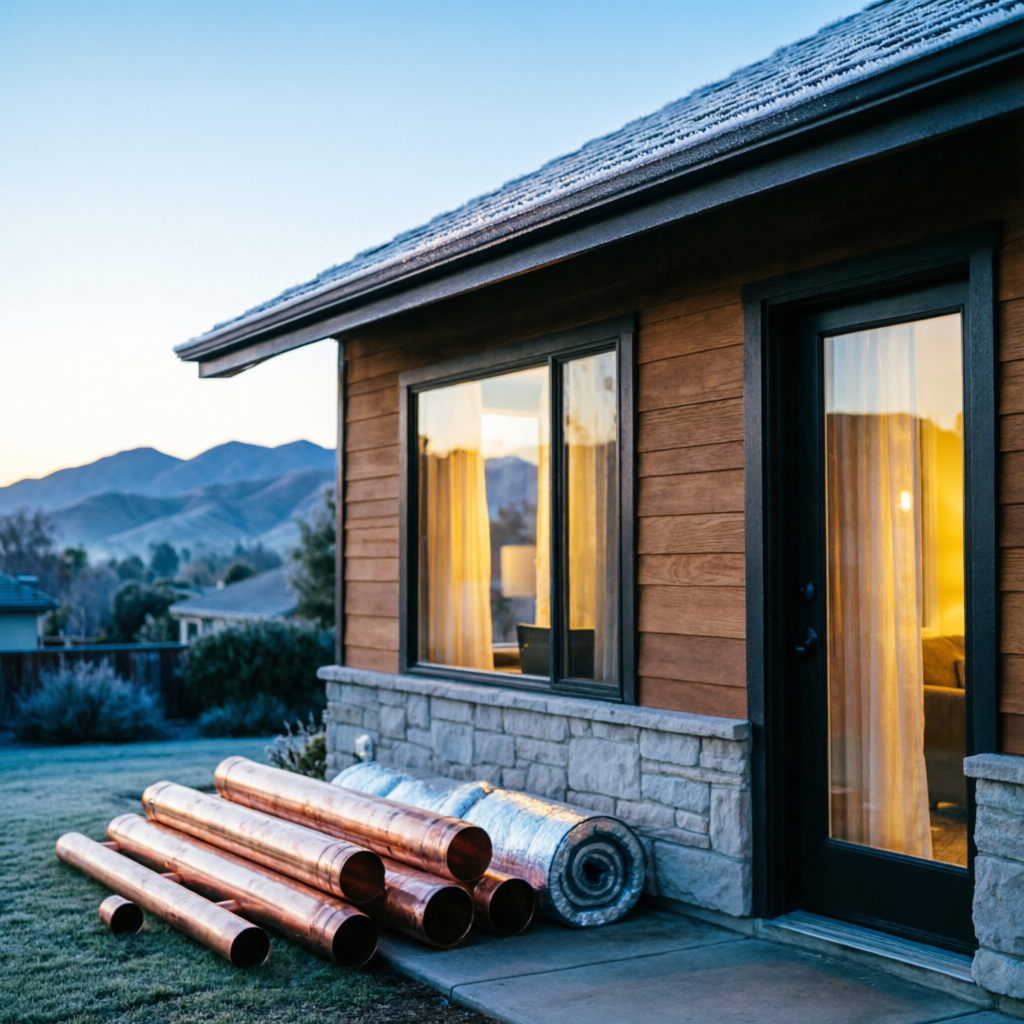
Every January, without fail, our San Diego dispatch desk lights up with calls that sound identical: "I woke up and there's no water," or "there's water pouring out of my ceiling," or "my hose bib snapped off in my hand." The common denominator? Homeowners who assumed San Diego's 72°F average meant winterization wasn't a thing.
It is a thing. Every winter, SD County sees a handful of nights where temperatures in the inland valleys, East County, and mountain communities drop below freezing — and even the coastal neighborhoods occasionally hit 33–35°F during cold snaps. The problem isn't the average temperature. The problem is that San Diego homes are built for heat, not cold. Pipes run through exterior walls. Hose bibs are exposed on outside walls. Garages and crawlspaces are uninsulated. Irrigation systems aren't drained.
After 14 years of repairing burst pipes across SD County — from a 12-burst night in Alpine during the 2019 cold snap to annual January calls in Ramona, Julian, and El Cajon — I've learned that 90% of the frozen-pipe damage we see is preventable with 45 minutes of prep work in late November.
Why San Diego homes are especially vulnerable
Counterintuitively, SD homes are more prone to freeze damage than homes in Minneapolis or Chicago — not because it's colder here, but because it's not. In cold-climate cities, building codes require pipes to run through interior conditioned spaces, insulated exterior walls, and heated crawlspaces. Frost-proof hose bibs are mandatory. In San Diego, none of that is required — because 99% of the year, it doesn't matter.
Here's the specific vulnerability profile of a typical SD home:
- Pipes in exterior walls. Post-war SD tract homes (1950s–70s) routinely ran copper supply lines through uninsulated exterior walls to reach kitchen sinks and bathrooms on outside walls. When the outside temperature drops, those pipes are exposed directly to cold air with only drywall and stucco between them and freezing.
- Non-frost-proof hose bibs. Most SD hose bibs are the old-style compression valves where the water shutoff sits right at the exterior wall. In cold-climate homes, frost-proof bibs extend the shutoff 12" inside the heated space. SD bibs don't — and they're the #1 freeze failure point in our service history.
- Uninsulated garages and crawlspaces. Many SD homes have the water heater in an uninsulated garage or the main supply line running through an unheated crawlspace. When the garage hits 32°F (common on cold nights even in La Mesa and El Cajon), those pipes freeze.
- Irrigation systems that aren't drained. Most SD homes have in-ground irrigation with backflow preventers and above-ground valves. When water remains in those components through a freeze night, they crack — and the leak often isn't discovered until the system turns on in spring.
- No "winterization culture." Homeowners in cold climates learn as kids to disconnect garden hoses and wrap outdoor spigots. In SD, that knowledge doesn't get passed down — because it's rarely needed. Until the one night it is.
Where SD freezes most — the risk map
Freeze risk in San Diego County is not uniform. Elevation and distance from the ocean are the two dominant factors. Here's how neighborhoods rank based on 14 years of our service data:
| Area | Freeze risk | Annual freeze nights |
|---|---|---|
| Julian (4,200 ft) | Very high | 60–80 nights |
| Alpine (2,000 ft) | High | 20–35 nights |
| Ramona (1,400 ft) | High | 15–25 nights |
| El Cajon / La Mesa | Moderate-high | 8–15 nights |
| Poway / Scripps Ranch | Moderate | 4–8 nights |
| North Park / Hillcrest canyons | Moderate | 3–6 nights |
| Chula Vista inland | Low-moderate | 1–3 nights |
| La Jolla / Coronado | Low | 0–1 night |
| Point Loma / Ocean Beach | Very low | Almost never |
The rule: If you're more than 8 miles inland and/or above 500 feet elevation, you're in freeze territory every winter. Coastal homeowners still need to winterize hose bibs and irrigation — but the urgency is lower.
Freeze-risk nights in San Diego County cluster between December 15 and February 15, with the peak typically in the third week of January. The cold snap usually lasts 3–5 nights in a row, with lows between 4am and 6am. That's your target window for winterization prep — do it in late November or early December, not when the forecast shows frost.
The 45-minute winterization routine
This is the exact checklist our technicians run on a winterization visit. Every step is DIY-able with materials from the hardware store. Plan 45 minutes on a Saturday morning in late November:
Step 1: Disconnect and drain every garden hose (5 minutes)
Walk the perimeter of your home and disconnect every garden hose from every hose bib. Drain the hoses completely (hold them vertically until water stops flowing), then coil and store them in the garage. A hose left attached to a bib traps water in the bib itself, and that trapped water is what expands and splits the bib when it freezes.
Step 2: Shut off and drain exterior hose bibs (10 minutes)
Locate the interior shutoff valve for each exterior hose bib — usually in the garage, crawlspace, or utility closet, labeled "exterior hose bib" or simply the valve that, when closed, stops flow to that specific outdoor spigot. Close each valve, then open the exterior bib and let any trapped water drain out. Leave the exterior bib open all winter — this gives any residual water a place to expand without splitting the pipe.
If you can't find the interior shutoff (common in older SD homes), install a dedicated shutoff valve — brass ball valve from the hardware store plus 30 minutes of work. It's the single best winterization investment you can make.
Step 3: Insulate exposed outdoor bibs (10 minutes)
Buy foam hose bib covers or wrap each exterior bib in foam pipe insulation secured with duct tape. The cover doesn't prevent freezing in sustained sub-32°F weather — it buys time. A covered bib will resist freezing for 4–6 hours in 28°F air; an uncovered bib freezes in 45–90 minutes.
Step 4: Drain and winterize the irrigation system (15 minutes)
Every SD irrigation system has a main shutoff (usually near the water meter or in the garage), a backflow preventer (the brass device with two test cocks, typically outside near the front of the house), and a controller. The winterization process:
- Shut off the main irrigation valve
- Open the two test cocks on the backflow preventer (usually ¼ turn with a flathead screwdriver)
- Open the two ball valves on the backflow device to 45° (halfway between open and closed) to let residual water drain
- Set the irrigation controller to "off" or "rain mode"
- Wrap the backflow preventer in a foam insulation cover or towel + duct tape
If your system has a manual drain valve at the low point (often near the backflow device or at the far end of the main line), open it to drain remaining water. Backflow preventers that freeze and crack to replace — plus potential water damage if they fail under pressure in spring.
Step 5: Insulate exposed pipes in garage and crawlspace (5 minutes)
Walk your garage, crawlspace, and attic with a flashlight and look for exposed copper or PEX water lines. Any pipe within 3 feet of an exterior wall, an uninsulated garage wall, or a vented crawlspace should be wrapped in foam pipe insulation . Slit the foam lengthwise, slip it over the pipe, and tape the seam with duct tape. Focus especially on:
- The cold water line feeding the water heater (if the heater is in the garage)
- Supply lines running across unheated garage ceilings
- The main shutoff valve and pressure-reducing valve near the water meter
- Any pipes in exterior walls accessible from the attic
Step 6: Locate and label your main water shutoff (2 minutes)
When a pipe bursts at 3am, the difference in damage is how fast you can kill the water. Every household member should know where the main shutoff is before an emergency. Find it, turn it off and on once to make sure it's not seized, and label it with painter's tape: "MAIN WATER — TURN CLOCKWISE TO CLOSE." See our emergency plumbing signs guide for a full tutorial on shutoffs.
Step 7: Know the cold-snap protocol (night before)
When the forecast calls for below 35°F overnight, do this before bed:
- Open cabinet doors under kitchen and bathroom sinks on exterior walls — this lets warm house air circulate around the pipes
- Set interior thermostat to at least 62°F overnight (many SD homeowners drop it to 55°F in winter to save money — not on freeze nights)
- Open one faucet (the one furthest from the water heater) to a slow drip. Moving water resists freezing much better than static water.
- Close garage doors completely — even a 2" gap lets cold air wash across pipes
What to do if a pipe freezes (not bursts)
You turn on a faucet and nothing comes out — or a thin trickle. The pipe is frozen, but hasn't burst yet. This is a salvageable situation if you move quickly:
- Open the faucet (both hot and cold) so water has a path to flow once the ice melts.
- Locate the freeze point. Feel along the pipe run for the coldest section — usually near an exterior wall, in a garage, or in a crawlspace. Frost on the outside of the pipe or a visible bulge confirms the location.
- Apply gentle heat. A hair dryer, heat lamp, or heating pad works best. Start at the faucet end of the frozen section and work toward the blockage — this lets melting water escape rather than being trapped behind ice. Never use an open flame, propane torch, or heat gun on high — these can damage the pipe or start a fire in wall cavities.
- Allow 30–60 minutes. A typical ½" copper freeze thaws in 30–45 minutes with steady hair-dryer heat. Don't rush it.
- Check for leaks once flow returns. Freezing can crack the pipe without fully rupturing it. Watch the thawed section carefully for 24 hours for slow leaks — even a small drip indicates a crack that needs repair.
Every winter we respond to at least one house fire started by a homeowner using a propane torch on a frozen pipe. The flame travels through the wall cavity to insulation or wood framing. Hair dryers and heating pads are slower but safe. An investment in heat tape (a plug-in heating cable that wraps the pipe) is the permanent fix for pipes that freeze repeatedly.
What to do if a pipe bursts
If you hear running water, see water spraying from a pipe, or discover standing water on the floor, you're past the frozen stage — the pipe has ruptured. Act immediately:
- Shut off the main water valve. Don't try to find the specific burst line first. Kill the main. Every second of flow adds gallons to the damage.
- Open downstream faucets to relieve residual pressure and drain remaining water from the lines.
- Turn off the water heater (gas valve to "pilot" or electric breaker off) to prevent overheating when the tank drains.
- Move valuables, electronics, and rugs out of the affected area.
- Call us. We dispatch 24/7 from our Fifth Avenue hub with an average response of 42 minutes across SD County.
- Call your homeowner's insurance once we arrive and stabilize the leak — they'll send a water damage restoration crew.
- Document everything with photos for the insurance claim — the source of the burst, the affected areas, and any damaged belongings.
Frequently asked questions
Yes — if you live inland or above 500 feet elevation, winterization is essential every year. If you live on the coast (La Jolla, Coronado, Point Loma, Ocean Beach), the risk is lower but you should still disconnect garden hoses and drain your irrigation system. Every winter we repair burst pipes in every SD neighborhood — including coastal ones — because homeowners assumed "it's San Diego, it doesn't freeze." One 30°F night is all it takes.
Late November or early December — before the first freeze-risk night, which typically arrives mid-to-late December. Don't wait for the forecast to show frost; by then it's too late to prep properly. The 45-minute DIY routine in this guide, or a winterization visit from us, is best done on a calm Saturday morning in late fall. If you're leaving town for the holidays, winterize before you go.
In most SD homes, the main shutoff is in one of three places: (1) the garage wall near the water heater, (2) the crawlspace access point, or (3) the exterior wall near the front of the house (often behind a small metal panel or near the hose bib). The valve is typically a chrome or brass gate valve (round handle, turns clockwise) or ball valve (lever, rotates 90°). If you can't find it, the secondary shutoff is at the water meter in the concrete box near the street. Our winterization visit includes locating, testing, and labeling your main shutoff.
Yes — on nights when the forecast calls for below 35°F, open the faucet furthest from your water heater to a slow drip (about 1 drip per second). Moving water resists freezing much better than static water, and the open faucet relieves pressure buildup if ice does form somewhere in the line. Focus on faucets fed by pipes in exterior walls, garages, or crawlspaces.
Yes — and this surprises many SD homeowners. Tankless water heaters (Navien, Rinnai, Noritz) have internal heat exchangers that hold a small amount of water even when not running. If the unit is installed in an unheated garage or on an exterior wall and the power goes out during a freeze night, that water can freeze and crack the heat exchanger. Most tankless units have built-in freeze protection that runs a small heater when powered, but it requires electricity. Solution: install the unit in a conditioned space if possible, or add a dedicated freeze-protection circuit. We spec this on every new tankless install in East County and mountain areas.
Usually yes — for the resulting water damage (drywall, flooring, furniture, belongings) but not for the repair of the pipe itself, which is considered maintenance. However, many insurers will deny claims if they can demonstrate negligence — for example, if the homeowner left the house for two weeks in January without winterizing and without shutting off the main valve. Read your policy's "freeze damage" section carefully. Most policies require that the home be "properly maintained" and heated to a minimum temperature — usually 55°F — during cold weather. Our burst-pipe repair reports document the cause and timing for your claim.
Before any winter vacation of more than 3 days, do one of two things: (1) shut off the main water valve and open the lowest faucet in the house to drain the lines, OR (2) install an automatic water shutoff valve that detects abnormal flow and kills the water automatically. Also ask a neighbor to check on your house every few days, keep the thermostat set to at least 58°F (not lower, even to save money), and leave a trusted contact's number with your neighbor in case they see water coming from under the garage door.
Let us winterize your SD home in 45 minutes.
A licensed SD technician walks your home, insulates every exposed pipe, drains the irrigation system, labels your main shutoff, and leaves you with a written checklist. Flat rate, no upsells.
Elena Vasquez
Lead Technician at Pacific Line's San Diego dispatch hub with 14 years of SD-specific field experience. Elena personally responded to 40+ burst-pipe calls during the January 2019 cold snap and wrote our winterization protocol. She lives in Alpine with a husband, two kids, and the most winterized house on the block.
Keep reading
San Diego Hard Water: What Every Homeowner Needs to Know in 2026
At 280–340 ppm, SD has California's hardest municipal water. Here's what that does to pipes, appliances, and your tankless unit.
Signs You Need Emergency Plumbing Repair — And When You Don't
Five warning signs that mean call now, and three situations where shutting off your main valve buys you time until morning.
Salt-Air Corrosion: Protecting Coastal SD Plumbing
From La Jolla to Coronado, marine layer salt spray eats through exposed copper in 5–8 years. Here's how to spec marine-grade fittings.