Tankless vs. Tank Water Heater: Which Is Right for Your California Home?
We've installed 1,400+ water heaters across Los Angeles and San Diego since 2008. Here's the honest, data-backed breakdown of efficiency, lifespan, real operating cost, and which system wins for which household — including the hard-water penalty San Diego homeowners must factor in.
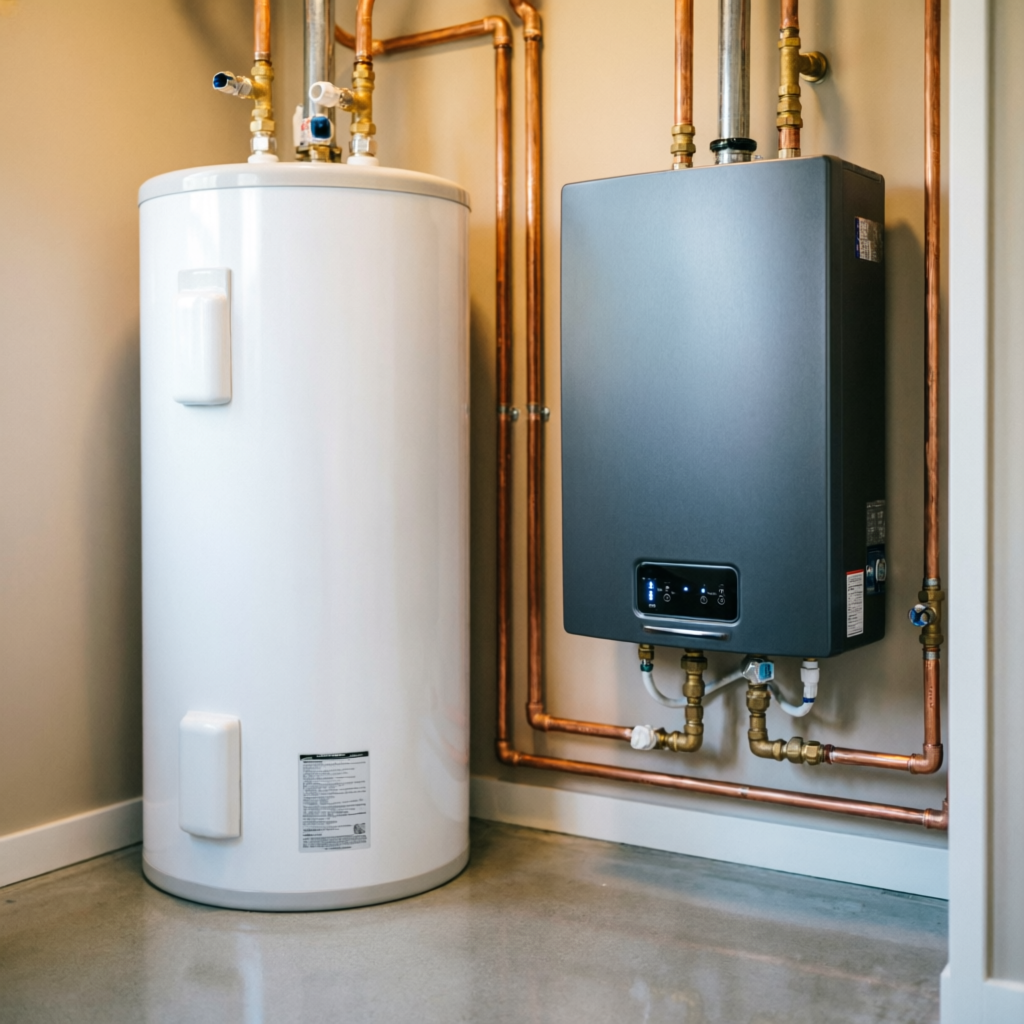
Walk into any big-box store and the tankless water heater is positioned like the Tesla of water heating — sleek, wall-mounted, "endless hot water," and roughly three times the sticker price of the big white tank next to it. The marketing practically writes itself: tankless is the future, tank is the past.
After 16 years and 1,400+ water heater installs across Los Angeles and San Diego, I can tell you the truth is more complicated. Tankless wins in some homes and loses badly in others — and the decision has less to do with the unit itself than it does with your household's hot water habits, your gas line size, and — in San Diego specifically — your water chemistry.
This guide is the exact conversation I have with every homeowner sitting at their kitchen table deciding between the two. No manufacturer bias (we install Rheem, Bradford White, Navien, Rinnai, and Noritz — so I don't care which one you pick), no "tankless is always better" cheerleading. Just the numbers, the failure rates, and the California-specific factors that actually drive the decision.
How each system actually works
Tank water heater
A tank water heater stores 40–75 gallons of pre-heated water in an insulated steel tank, ready to use the moment you open a faucet. A gas burner (or electric elements) cycles on and off to maintain the set temperature — typically 120–130°F — 24 hours a day, whether you're home or on vacation.
When you turn on a hot tap, hot water flows out of the top of the tank while cold water enters through a dip tube at the bottom. Once the tank's temperature drops below the setpoint, the burner fires to bring it back up. Recovery time (how long it takes to reheat a full tank) is typically 45–75 minutes for a 50-gallon gas unit.
When you run out of hot water — usually mid-shower with a family of four — you wait for recovery. That's the fundamental limitation.
Tankless water heater
A tankless unit has no stored hot water. When you open a hot tap, a flow sensor triggers a high-output gas burner that heats water as it passes through a copper or stainless-steel heat exchanger. Hot water arrives at the fixture in the same time as a tank system (whatever the cold water in your pipes takes to reach the faucet), but the supply is theoretically unlimited.
Output is measured in gallons per minute (GPM) at a specific temperature rise. A Navien NPE-240A, for example, delivers 11.2 GPM at a 35°F rise — meaning it can raise incoming 55°F groundwater to 90°F at 11.2 GPM, or to 120°F at about 7.5 GPM. Run more than that and the water comes out lukewarm.
The critical caveat: tankless units need significantly more gas than tanks — often 199,000 BTU/hr versus 40,000 for a tank. Many older California homes have ¾" gas lines that can't deliver that flow without a gas line upgrade.
Efficiency and operating cost
This is where tankless has its cleanest win — and where the marketing exaggerates the least.
| Metric | Standard tank (gas) | Tankless (gas) |
|---|---|---|
| Energy Factor (EF) | 0.62–0.67 | 0.90–0.97 |
| Standby heat loss | ~15–20% of total use | Near zero |
| Annual savings vs tank | — |
A tank loses heat through its walls 24/7 — what engineers call "standby loss." That's 15–20% of a tank's energy use, spent on water nobody's using. A tankless has essentially zero standby loss because there's no stored water to lose heat from.
Lifespan and reliability
| System | LA lifespan | SD lifespan |
|---|---|---|
| Tank (gas) | 8–12 years | 6–9 years |
| Tank (electric) | 10–15 years | 8–12 years |
| Tankless (gas) | 15–20 years | 10–15 years* |
| Hybrid heat pump | 12–15 years | 10–13 years |
* Tankless lifespan in SD is contingent on annual professional descaling. Without it, heat exchanger failure in 3–5 years is common.
Tankless wins on lifespan by a wide margin — in theory. A quality Navien or Rinnai unit has a stainless-steel heat exchanger and replaceable components that let it run 15–20 years with proper maintenance. Tank water heaters are fundamentally limited by the sacrificial anode rod and internal tank corrosion; once the tank itself rusts through, the unit is a total loss.
But in San Diego, the hard water (280–340 ppm) changes the math. Without an annual descaling flush, calcium scale coats the tankless heat exchanger within 12–18 months. Efficiency drops. Error codes appear. I've pulled heat exchangers out of La Jolla homes that were fully occluded with scale after just 14 months.
In Los Angeles, where water runs 120–160 ppm, tankless maintenance is still important but the stakes are lower. A tankless unit can stretch to 18–24 months between descals in LA water. In SD, it's annual — no exceptions.
The San Diego hard-water penalty
If you live in La Jolla, Coronado, Carlsbad, or anywhere else in SD County, this section matters more than anything above it.
San Diego County Water Authority delivers some of California's hardest water at 280–340 ppm. Tank water heaters handle this by slowly accumulating sediment at the bottom of the tank — a problem, but one that annual flushing handles. Tankless units handle it worse: calcium scale coats the heat exchanger's internal passages, restricting flow, dropping efficiency, and eventually cracking the exchanger.
The practical impact on the tankless-vs-tank decision in SD:
- Annual descaling is non-negotiable. If you won't commit, don't buy tankless.
- Whole-home water softener strongly recommended. A softener install dramatically extends heat exchanger life. Pair it with tankless and you get the best of both worlds.
- Tank units die faster too — 6–9 years vs 8–12 in LA. But the replacement cost is lower, and the maintenance burden is lighter.
My honest recommendation for SD homeowners: if you're also installing a whole-home softener, go tankless. The combination is the best-performing setup we spec. If you're not installing a softener and you won't commit to annual descaling, go tank — it's more forgiving of neglect.
We break this down in more detail in our San Diego hard water guide.
Don't size a tankless unit based on the number of bathrooms. Size it based on the maximum simultaneous GPM demand your household actually runs. A 3-bathroom home that never runs two showers at once needs less capacity than a 2-bathroom home where two people shower at 6:30am every morning.
Space, gas, and installation quirks
Space savings
Tankless wins decisively. A tank unit eats up roughly 20 square feet of floor space in your utility closet or garage. A tankless unit mounts on the wall in about 4 square feet, freeing up space for storage, a laundry setup, or — in tiny LA bungalows where the water heater lives in a kitchen closet — actual living space.
For hillside homes in Silver Lake, Hollywood, and Echo Park where utility space is precious, space savings alone often drives the tankless decision.
Gas line requirements
This is the hidden cost that surprises most homeowners. A standard 50-gallon gas tank pulls about 40,000 BTU/hr. A tankless unit pulls 180,000–199,000 BTU/hr — 4–5× more gas. Many older California homes have ¾" gas lines from the meter that can't deliver that flow when the furnace and stove are also running.
Venting
Tank units vent through a simple B-vent chimney that most homes already have. Tankless units require sealed stainless-steel concentric venting (intake and exhaust in one pipe), which often means a new penetration through an exterior wall. Homes with interior water heater closets need a longer vent run to reach outside — another cost adder.
Cold water sandwich
Tankless units have a known quirk called the "cold water sandwich": when you turn on a hot tap, then off, then on again quickly (common when shaving or washing dishes), you get a burst of hot water (from the previous run still in the heat exchanger), then cold (the water that flowed while the burner was re-igniting), then hot again. Some units with built-in buffer tanks eliminate this; budget models don't.
Which wins when — our decision framework
Choose tankless if:
- Your household runs 60+ gallons of hot water daily
- Multiple people shower simultaneously or back-to-back
- You plan to stay in the home 10+ years
- Utility space is tight or premium
- Your gas line is already 1¼" or larger
- In San Diego: you're also installing a water softener
- You'll commit to annual descaling maintenance
Choose tank if:
- Budget is the primary driver
- Your home has an older ¾" gas line and upgrade is cost-prohibitive
- You plan to sell the home within 5 years (won't recoup tankless premium)
- Your household uses under 40 gallons of hot water daily
- You want the lowest-maintenance option (annual flush, no descaling)
- Your home has a simple B-vent chimney that a tankless can't use
Consider hybrid (heat pump) if:
- Your water heater lives in a conditioned space (garage, basement, interior closet)
- You're electrifying your home to move off natural gas
- You have 240V electrical service available at the location
Hybrid heat pump units installed but use 60–70% less energy than standard electric tanks. The IRA credit brings net cost down in many cases — and they work beautifully in California's mild climate.
Frequently asked questions
For most California households using 60+ gallons of hot water daily, yes — tankless pays for itself over its 15–20 year lifespan in energy savings and longevity. For low-usage households under 40 gallons/day, the ROI weakens. In San Diego specifically, tankless only makes sense paired with a water softener or a commitment to strict annual descaling. For a household replacing a water heater they plan to live with for 15+ years, tankless is our default recommendation.
Tank water heaters last 8–12 years in Los Angeles and 6–9 years in San Diego due to hard water. Tankless water heaters last 15–20 years in LA and 10–15 years in SD — but only with documented annual descaling maintenance. Without annual service, a tankless unit in San Diego can fail in 3–5 years. Tankless also has replaceable internal components, while a tank is a sealed unit — once the tank rusts through, the whole thing is replaced.
You never run out of hot water, but you can exceed the unit's flow capacity. A tankless unit rated for 7.5 GPM at 120°F will deliver endless hot water at that flow — but if you run three showers at 2.5 GPM each (7.5 GPM total) plus a dishwasher (1.5 GPM), you've exceeded capacity and the water will come out lukewarm. We size tankless units based on your household's peak simultaneous demand, not the number of bathrooms.
The cold water sandwich is a known tankless quirk: when you turn on a hot tap, turn it off briefly, then on again, you get hot-cold-hot in sequence. It's caused by the residual hot water from the previous run, followed by water that flowed during burner re-ignition, followed by freshly heated water. Higher-end units (Navien NPE-A series, Rinnai RUR) include a small built-in buffer tank that eliminates the effect. Budget models don't — and the sandwich is noticeable, especially at the kitchen sink.
Often, but not always. Tankless mounts on a wall, so you need a suitable exterior wall for venting or a viable vent run to an outside wall. The existing gas line (usually ¾" for a tank) often needs upgrading to 1¼" to handle the tankless BTU demand. The existing electrical (120V for tank control board) is usually sufficient, but condensing tankless units need a condensate drain. We evaluate all of this during the free estimate so there are no surprises on install day.
Yes — but the maintenance is what lets them last 15–20 years instead of 8–12. A tankless unit requires annual descaling to keep the heat exchanger clean. A tank requires annual flushing and anode rod inspection/replacement every 3–5 years.
Not sure which system fits your home?
Book a flat-rate diagnostic with a licensed technician. We'll evaluate your gas line, hot water demand, and water chemistry — and give you a written tank vs. tankless recommendation.
James Tran
Senior Technician at Pacific Line with 16 years of field experience. James has installed over 1,400 water heaters across LA and SD and is factory-certified on Navien, Rinnai, Bradford White, and Rheem systems. He leads our water heater training program and lives in Glendale with a Navien NPE-240A and a whole-home softener in his own garage.
Keep reading
Why Your Water Heater Is Making That Noise (And What to Do)
Popping. Rumbling. Banging. Hissing. Every sound tells you something specific — here's how to decode them.
San Diego Hard Water: What Every Homeowner Needs to Know in 2026
At 280–340 ppm, SD has some of California's hardest water. Here's what that does to your tankless unit.
The True Cost of Plumbing Services in Los Angeles (2026)
Service-by-service pricing breakdown with LA-specific factors that affect your final bill.