PEX vs. Copper Repiping: The California Homeowner's Decision Guide
After 800+ repipes across Los Angeles and San Diego since 2008, here's our honest take: when copper is still the right call, when PEX-A wins on every metric, and the specific situations where we spec each material — with real 2026 pricing from our last 240 repipe jobs.
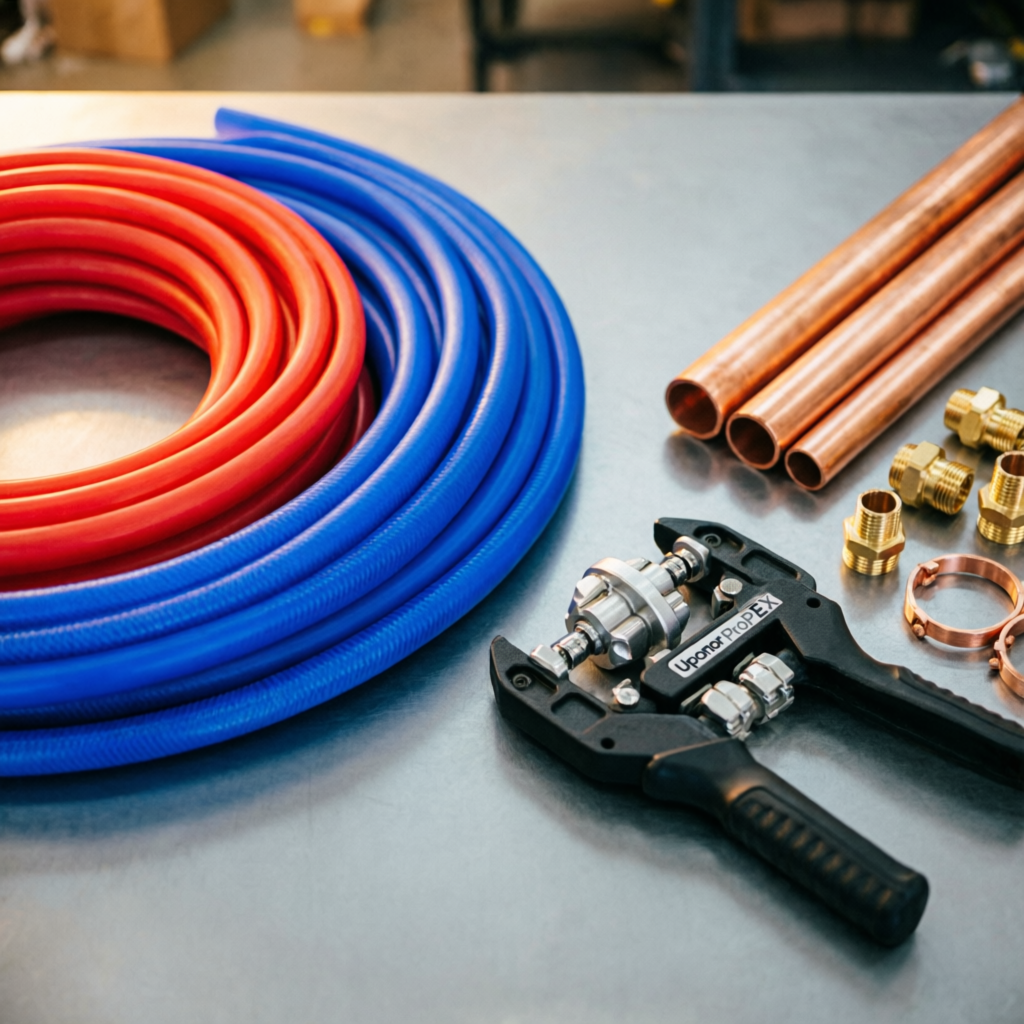
If your home was built before 1990 and you've had two or more pinhole leaks, recurring slab leaks, or brown water out of the tap, you're probably facing a whole-home repipe. That means choosing between two materials: traditional copper or modern PEX plastic tubing. The choice isn't aesthetic — it affects your water quality, the cost of the job, how long the new system lasts, and how your home responds to California's specific water chemistry.
Since 2008, Pacific Line has completed over 800 whole-home repipes across Los Angeles County and San Diego County. Roughly 72% have been PEX-A (Uponor), 22% have been copper type L, and 6% have been hybrid (copper for main trunk, PEX for branch runs). We spec both materials weekly — I have no financial incentive to push one over the other.
This guide is the exact conversation I have at every kitchen table estimate. Here's what's true, what's marketing, and which material is right for which California home in 2026.
Copper: the 70-year standard
What it is
Copper has been the default residential water supply material in California since the 1950s. Type L copper (medium wall thickness) is the standard for in-wall residential use; Type K (thicker) is used underground; Type M (thinner) is mostly commercial.
Where copper wins
- UV resistance. Copper can be run outdoors, exposed to direct sunlight, without degradation. PEX cannot — UV breaks down PEX within 30–60 days of direct exposure. Any exterior run (pool equipment, outdoor kitchen, hose bibs) is still copper.
- Fire resistance. Copper doesn't burn and doesn't emit toxic smoke in a house fire. For homes in wildfire zones — Malibu, Pacific Palisades, Topanga, parts of San Diego's backcountry — some homeowners and insurers prefer copper for runs through attic spaces.
- Longevity track record. We have 70-year data on copper. Properly installed Type L copper in a home with neutral water chemistry regularly lasts 50–70 years. PEX has only been in widespread US use since ~2000, so real-world longevity data is about 25 years old.
- Perceived home value. In high-end markets (Beverly Hills, Pacific Palisades, La Jolla, Del Mar), some buyers and appraisers still view copper as the premium material. Copper repipes can be a positive line item in luxury home inspections.
Where copper loses
- Pinhole leaks in aggressive water. San Diego's 280–340 ppm hard water plus chloramine disinfection creates pitting corrosion in copper. Homes in La Jolla, Coronado, and Point Loma with coastal salt air get hit from both inside and outside.
- Theft risk. Copper theft from vacant homes, foreclosures, and remodel sites has surged since 2020. Exterior copper runs are a target. PEX has no scrap value.
- Installation cost. Copper prices have risen roughly 40% since 2020. Combined with slower labor (sweating joints vs. PEX expansion), a copper repipe costs 40–60% more than PEX-A.
- Freeze vulnerability. Copper freezes and bursts at the same temperatures as PEX, but PEX can expand up to ½" diameter before rupturing. Copper cannot expand at all. Relevant for East County SD and mountain properties.
PEX: not all PEX is created equal
"PEX" is a generic term for cross-linked polyethylene tubing, but there are three distinct manufacturing methods with meaningfully different properties. Spec the wrong one and you're asking for callbacks.
PEX-A (Engel method, peroxide cross-linked)
The highest-performing PEX, made by Uponor (formerly Wirsbo) and a few others. Cross-linked at 80–85%, the most uniform molecular structure, and the most flexible. Uses expansion fittings — the tubing is expanded with a special tool, a fitting is inserted, and the tubing shrinks back to create a joint stronger than the tubing itself.
PEX-B (Silane method, moisture cross-linked)
Cross-linked at 65–70%. Stiffer than PEX-A, less kink-resistant. Uses crimp or clamp fittings — a brass fitting is inserted and a copper or stainless ring is crimped around the outside. Joint is mechanically sound but more prone to flow restriction and harder to repair in tight spaces.
Common at big-box stores, cheaper than PEX-A, and perfectly adequate for short runs or new construction. We don't spec PEX-B for whole-home repipes because of the higher fitting count and lower flexibility.
PEX-C (Electron beam method)
Cross-linked at 70–75%. The least uniform structure of the three, with the outer layer more cross-linked than the core. More prone of the three to kinking and cracking at bends. Used mostly in radiant floor heating, not potable water distribution. We do not install PEX-C for repipes, and we recommend against it if a contractor proposes it.
Side-by-side: copper vs. PEX-A in 2026
| Factor | Copper Type L | PEX-A (Uponor) |
|---|---|---|
| Material cost | $$$$ | $$ |
| Labor time (avg 2BR home) | 4–6 days | 2–3 days |
| Expected lifespan | 50–70 years* | 40–60+ years |
| Hard water resistance (SD) | Poor | Excellent |
| Chloramine resistance | Poor | Excellent |
| Freeze burst resistance | Poor | Excellent |
| UV exposure outdoors | Excellent | Poor |
| Fire resistance | Excellent | Good (rated for residential) |
| Theft risk | High | Zero |
| Water hammer resistance | Poor | Excellent (flex absorbs) |
* Copper lifespan assumes neutral water chemistry. In San Diego's 280+ ppm hard water with chloramine, realistic lifespan is 25–40 years.
San Diego hard water: where PEX dominates
If you live in San Diego County, the hard water discussion isn't optional — it's the single biggest factor in your repipe decision.
SD County Water Authority delivers water at 280–340 ppm with aggressive chloramine disinfection. The combination creates pitting corrosion in copper — microscopic galvanic cells form under scale deposits and eat through the pipe wall from the inside. The result is pinhole leaks that appear seemingly at random: behind a shower wall, under a kitchen sink, in the ceiling above the dining room.
We see pinhole leak rates in San Diego roughly 2× higher than in Los Angeles. Coastal neighborhoods add salt-air corrosion on the outside of exposed pipes, accelerating failure from both directions.
PEX is chemically inert to both hard minerals and chloramine. It doesn't pit, doesn't corrode, and doesn't scale internally the way copper does. For SD homeowners — especially in La Jolla, Coronado, Point Loma, and Ocean Beach — PEX-A is our default recommendation for whole-home repipes. We install PEX on roughly 85% of our SD repipes; the other 15% are copper, typically in high-end homes where the owner specifically requests it for perceived value.
For more detail on what SD's water does to plumbing, see our San Diego hard water guide.
Los Angeles post-war homes: a copper-specific story
Between 1945 and 1975, Los Angeles built roughly 400,000 slab-on-grade homes — from the San Fernando Valley to Long Beach, Silver Lake to Pasadena. Every one of those slabs buried copper water lines directly in concrete, with no access from below.
Seventy years later, those lines are failing — not just from age, but from three LA-specific factors:
- Reactive clay soil that swells and shrinks seasonally, flexing pipes at every joint
- Stray electrical current in the ground creating electrolytic corrosion
- Direct concrete embedment with no protective sleeving (pre-1970s practice)
When these homes need a repipe, we almost never re-bury new copper under the slab — that's repeating the same failure mode. Instead, we reroute water distribution above-ground: new lines run through the attic, down interior walls, and through crawl spaces where accessible. Both PEX-A and copper can be run this way, but PEX's flexibility means fewer fittings, faster install, and the ability to pull long continuous runs through tight attic chases.
For LA post-war slab homes, we recommend PEX-A for roughly 80% of repipes, with copper reserved for exterior runs, exposed mechanical room work, and owner-requested premium installs.
The slab leak diagnosis that usually leads to a repipe is covered in our complete slab leak detection guide.
Our decision framework
Choose PEX-A when:
- Your home is in San Diego County (280–340 ppm water)
- You've already had 2+ pinhole leaks in copper
- Your home has a slab foundation with under-slab leaks
- You want the fastest install (2–3 days vs 4–6)
- You're in a high copper-theft area or have a vacation property
- Your home is prone to water hammer (PEX flex absorbs shock)
- Freeze risk exists (East County SD, mountain properties)
Choose copper when:
- Any portion of the system runs outdoors exposed to sunlight
- Your home is in a high wildfire zone and runs pass through attic space
- Your home is in a luxury market where copper carries perceived value (Beverly Hills, Pacific Palisades, La Jolla Shores)
- You have a strong personal preference for metal pipe and plan to stay 20+ years
- Your water chemistry has been tested and is neutral (rare in SD, more common in parts of LA)
- You're connecting to existing copper runs and want material consistency
Choose hybrid (copper trunk + PEX branches) when:
- Your home has a long main supply run through a crawlspace (copper is more rigid)
- Your water heater is far from the furthest fixture and you want a recirculation-compatible main
- You have specific fire-rated penetrations that require metal pipe
- You want the longevity of copper at the main with the cost savings of PEX at branches
Every repipe estimate from Pacific Line includes a written material recommendation with rationale. We don't default to the easiest install — we spec what the home and the water chemistry actually need.
Frequently asked questions
Yes. PEX-A (Uponor) is certified to NSF/ANSI 61 for potable water and meets California's lead-free AB1953 standard. It's approved by the California State Water Resources Control Board and used in hospitals, schools, and municipal buildings throughout the state. Early-generation PEX (1990s–2000s) had some reported taste/odor issues that have been resolved in modern formulations. Uponor PEX-A is also certified to NSF/ANSI 372 for lead-free compliance.
PEX-A has a documented 50+ year expected lifespan under normal residential conditions. The material has been in widespread European use since the 1970s and US use since ~2000, so real-world longevity data spans about 45 years in Europe and 25 years in the US.The oldest PEX-A we've pulled out was in a 2002 remodel — the tubing was in perfect condition at 22 years old.
Yes. A whole-home repipe requires a plumbing permit from LADBS (Los Angeles), DSD (San Diego), or the relevant municipal building department. The permit ensures the work is inspected for code compliance — critical for your insurance coverage and future home sale. Pacific Line handles all permit applications, scheduling, and inspection coordination as part of our quoted price.
A PEX-A repipe on a typical 2-bathroom home takes 2–3 days. A copper repipe on the same home takes 4–6 days. Water is shut off during work hours (typically 8am–5pm) and restored each evening so you can use the kitchen and bathrooms overnight. Most homeowners stay in the home during the work. We protect floors, furniture, and countertops, patch all drywall access holes, and haul away all debris. We've never had a homeowner need to relocate during a repipe.
This is a legitimate concern in some Southern California homes — rats and mice can and do chew PEX. In 16 years of repipes, we've had three documented rodent-chew incidents, all in homes with active infestations in attic or crawlspace areas. Our mitigation: any PEX run through a rodent-accessible area (attic, crawlspace, garage wall cavity) is sleeved in flexible metal conduit or installed in sealed chase. If your home has an active rodent problem, we recommend resolving that before a repipe. Copper is not chewed by rodents, which is one legitimate argument for copper in rodent-prone attics.
A repipe rarely adds to appraised value directly, but it removes a significant negative. Homes with aging or leak-prone plumbing routinely see purchase-price reductions during inspection negotiations, and some buyers walk away entirely. In luxury markets (Beverly Hills, La Jolla, Pacific Palisades), copper repipes are sometimes viewed as a premium upgrade and can add modest perceived value. In most middle-market California homes, the ROI is in risk elimination rather than value addition.
If your home is over 50 years old with original cast iron or clay tile sewer lateral, yes — strongly consider doing both at once. You're already paying for mobilization, access points, and permit coordination. A camera inspection during the repipe estimate will tell you the sewer line's condition. If we see root intrusion, offsets, or significant corrosion, bundling the sewer repair saves. See our sewer line warning signs guide for more detail.
Let's spec the right material for your home.
Book a free in-home repipe estimate. A licensed technician will map your current plumbing, test your water chemistry, and give you a written PEX-A vs. copper recommendation with real pricing for both.
James Tran
Senior Technician at Pacific Line with 16 years of field experience. James has personally led over 420 whole-home repipes across LA and SD, holds certifications from Uponor (PEX-A) and Viega (press-fit copper), and is our in-house expert on matching material to water chemistry. He lives in Glendale with PEX-A in his own 1954 ranch.
Keep reading
The Complete Guide to Slab Leak Detection in Los Angeles Homes
Post-war LA bungalows hide aging copper under concrete. Here's how electronic detection pinpoints leaks without demolition.
Galvanized Steel Pipes in LA: When to Repair vs. Repipe
If your Hollywood or Pasadena home was built before 1970, galvanized steel may still be in your walls.
San Diego Hard Water: What Every Homeowner Needs to Know in 2026
At 280–340 ppm, SD has California's hardest municipal water. Here's what that does to pipes and appliances.