The Complete Guide to Slab Leak Detection in Los Angeles Homes
Post-war LA bungalows from Silver Lake to Sherman Oaks hide aging copper water lines under concrete slab foundations. Our founder breaks down how electronic detection pinpoints leaks without demolition — and what repair actually costs in 2026.
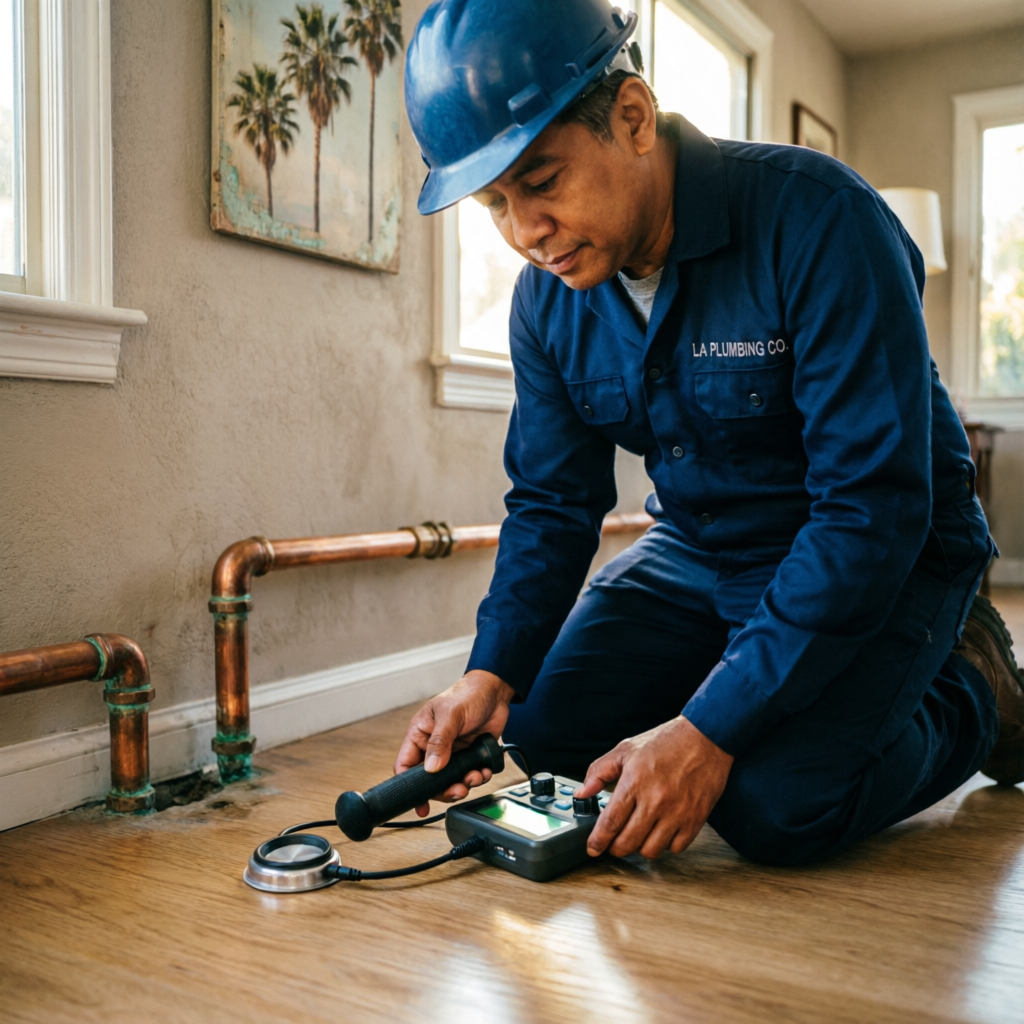
Los Angeles was built on concrete. Between 1945 and 1975, developers poured roughly 400,000 slab-on-grade foundations across the basin — from the San Fernando Valley to Long Beach, Silver Lake to Pasadena. Every one of those slabs buried copper water lines directly in the concrete, with no access panel, no crawl space, and no way to see what's happening underneath.
Seventy years later, those copper lines are failing. Not slowly. Not gracefully. They corrode from the inside out, from the outside in, and — in LA's reactive clay soil — from electrolysis caused by stray current in the ground itself.
After 22 years of chasing leaks under LA slabs, I've detected over 3,200 slab leaks. I've learned that the difference between a repair and foundation remediation is almost always how quickly you catch it — and whether your plumber uses electronic detection or starts jackhammering on guesswork.
A slab leak you can't see is a slab leak that's washing away the soil holding up your house. Detection isn't an expense — it's insurance. Marcus Chen, Founder · Pacific Line Plumbing
What is a slab leak — and why LA is ground zero
A slab leak is any failure of the water supply lines or drain lines buried beneath a home's concrete foundation. In Los Angeles, the overwhelming majority are hot water copper lines — because hot water accelerates internal corrosion roughly 3× faster than cold water, and because thermal expansion creates friction against the concrete encasing the pipe.
LA is uniquely vulnerable to slab leaks for four reasons:
- Post-war construction boom. Between 1945 and 1970, LA County added more slab-on-grade housing than any other metro in the country. Those homes are now 55–80 years old — well past the 40–50 year expected life of embedded copper.
- Reactive clay soil. Much of the LA basin sits on expansive clay that swells when wet and shrinks when dry. This seasonal movement stresses buried pipes at every joint.
- Seismic micro-movement. Even small earthquakes (3.0–4.5 magnitude) shift foundations enough to create new stress points on already-aged copper.
- LADWP water chemistry. LA's water runs 120–160 ppm hardness with aggressive chloramine disinfection — both of which attack copper from the inside, creating pinhole leaks that start microscopic and grow.
Seven warning signs of a slab leak
Catch these early and you're looking at a repair. Miss them and you're looking at foundation remediation, mold abatement, and potentially a full repipe. Here are the signs in descending order of urgency:
1. Unexplained spike in water bill
The single most reliable early indicator. If your LADWP bill jumps 30%+ month-over-month with no change in household behavior, you have a leak somewhere — and under-slab is the most common location in LA homes without basements or crawl spaces. Check your meter: turn off every fixture, wait 15 minutes, and watch the dial. Any movement means a leak.
2. Hot spots on the floor
Walk barefoot across tile, laminate, or hardwood first thing in the morning. Warm spots — particularly near bathrooms, kitchens, or laundry rooms — indicate a hot water line leaking under the slab. The heated concrete transfers warmth to the flooring above.
3. Sound of running water with all fixtures off
A faint hissing, rushing, or dripping sound coming from the floor itself — most audible at night when the house is quiet. This is water escaping under pressure from a pinhole or joint failure.
4. Cracks in walls, tile, or foundation
New diagonal cracks radiating from door frames. Cracked floor tile in a straight line. Separation between baseboards and the floor. These indicate foundation movement from soil erosion beneath the slab — often caused by a long-running leak washing away supporting soil.
5. Damp carpet, warping hardwood, or lifting tile
Moisture wicking up through the slab from below. Often mistaken for a surface spill or appliance leak, but the moisture pattern is persistent and grows outward over days.
6. Low water pressure
A significant leak diverts flow before it reaches fixtures. If pressure has dropped across the entire house (not just one faucet), a main line leak under the slab is a prime suspect.
7. Mildew smell or mold growth at baseboards
Chronic moisture under the slab migrates upward through concrete's porous matrix. Persistent mildew smell, especially in interior rooms without plumbing fixtures, points to a hidden slab leak.
If you're seeing standing water, active buckling of flooring, or structural cracks wider than ¼", shut off your main water valve and call for emergency service. Long-running slab leaks can undermine foundation footings and cause catastrophic settling.
How electronic slab leak detection actually works
The old-school method was "isolate and jackhammer" — shut off sections of pipe, watch the meter, and break concrete where you think the leak is. Success rate: roughly 60%, with a lot of patched concrete and wasted labor.
Modern electronic detection uses four complementary tools. We use all four on every call — never just one — because each has blind spots that the others cover.
Acoustic ground microphones
Ultra-sensitive contact microphones placed directly on concrete, tile, or hardwood amplify the specific frequency signature of pressurized water escaping through a pinhole. Our technicians train for 6–12 months to distinguish leak signatures from ambient noise (HVAC, traffic, refrigerator compressors). Effective in 85% of slab leak cases.
Electromagnetic pipeline locators
Before we listen for the leak, we have to know exactly where the pipe runs. Electromagnetic locators trace the path and depth of buried copper lines by inducing a signal onto the pipe. This maps the entire under-slab plumbing system without a single drill hole — essential context for interpreting acoustic data.
Thermal imaging cameras
Infrared cameras detect temperature differentials in the slab caused by hot water leaks. A hot line leaking under concrete creates a visible thermal plume that spreads through the slab over hours. Most effective for hot water leaks; less reliable for cold lines. We use FLIR T540 cameras with 320×240 resolution.
Static pressure testing
Isolating sections of the plumbing system and measuring pressure drop over 15–30 minutes confirms which branch line is leaking — hot side vs. cold side, main vs. branch. This narrows the search area before acoustic tools go to work.
The result: we pinpoint slab leaks within an 18-inch radius, 94% of the time, before any concrete is broken. That's the difference between a 2×2-foot access hole and a torn-up living room.
Three repair options — and when each is right
Option 1: Spot repair
Break concrete at the exact leak location (typically a 2×2 or 3×3 foot area), expose the pipe, cut out the failed section, install new copper or PEX with press-fit couplings, pressure-test, and re-pour concrete. Best when:
- The home has had only one or two slab leaks total
- The rest of the copper system tests within normal parameters
- The home is under 50 years old with no history of aggressive water chemistry damage
- Budget constraints make full repipe impossible in the near term
Option 2: Reroute above-ground
Abandon the leaking under-slab line entirely and run new PEX piping through walls, attic, or crawl space to bypass the slab. Best when:
- The leak is in a hard-to-access area (under a kitchen island, load-bearing wall)
- The home has had multiple slab leaks on the same branch line
- The homeowner wants to eliminate future slab leak risk on that line without a full repipe
Option 3: Whole-home repipe
Replace all under-slab and in-wall water lines with PEX-A (Uponor) or copper. Abandon every buried line. Run new water distribution through attic and walls. This is the permanent solution, and it's what we recommend when:
- The home has had 3+ slab leaks in the past 5 years
- The home was built between 1945–1970 with original copper
- Wall thickness measurements show widespread copper thinning
- The homeowner plans to stay in the home 10+ years
We published a full PEX vs. copper decision guide that breaks down material choice for LA homes specifically.
Prevention strategies for LA homeowners
You can't stop copper from aging, but you can extend its life and catch failures early:
- Water pressure regulation. LADWP pressure can spike to 120+ PSI in hillside areas. Install a pressure-reducing valve set to 65 PSI — every 10 PSI over 60 shortens copper life significantly.
- Whole-home water filtration. Catalytic carbon filters reduce chloramine levels, which are a primary driver of internal copper pitting in LA.
- Know your main shutoff valve. When a slab leak does occur, the difference between a minor repair and major foundation damage is how fast you kill the water. Every household member should know where the main valve is and how to turn it off.
- Replace proactively at 50 years. If your home was built before 1975 and still has original under-slab copper, schedule a pipe thickness inspection. Proactive repipe costs 30–40% less than emergency repair after a catastrophic failure.
Frequently asked questions
Most California homeowners policies cover the resulting damage from a slab leak — torn-up flooring, damaged drywall, ruined furniture — but not the repair of the pipe itself, which is considered maintenance. Some policies include "access and egress" coverage that pays for concrete breaking and restoration to reach the leak. Review your policy's water damage exclusions carefully; many insurers have added slab leak sub-limits in the past decade.
A thorough electronic slab leak detection typically takes 2–4 hours for an average single-family home. Straightforward leaks in accessible areas may be pinpointed in under 90 minutes; complex multi-leak scenarios or homes with extensive under-slab plumbing can take up to 6 hours. We never rush detection — a mislocated leak means breaking concrete in the wrong place.
The general rule: if your home has had 3+ slab leaks, if the home is over 50 years old with original copper, or if the spot repair would cost more than 40% of a full repipe, replacement is the better long-term decision. A spot repair fixes one leak; a repipe eliminates every future slab leak risk. We recommend pipe thickness testing after any slab leak to determine the remaining life of the system.
Yes. Modern electronic detection uses acoustic sensors, electromagnetic locators, and thermal cameras placed on the surface of floors — no drilling, no breaking concrete, no damage. The only concrete breaking happens during the actual repair, after the leak has been precisely located. This is the single biggest advantage over older "isolate and guess" methods.
Let's find that leak before it finds your foundation.
Book an electronic slab leak detection with a licensed technician. Pinpoint accuracy, no unnecessary concrete breaking, flat-rate pricing.
Marcus Chen
Founder of Pacific Line Plumbing and a third-generation Los Angeles plumber with 22 years of field experience. Marcus has personally detected over 3,200 slab leaks across LA County and leads the company's technical training program. He lives in Silver Lake in a 1948 bungalow — with fully replaced PEX plumbing.
Keep reading

PEX vs. Copper Repiping: The California Homeowner's Decision Guide
After 800+ repipes across LA and SD, here's our honest take on when copper wins and when PEX-A wins on every metric.
Galvanized Steel Pipes in LA: When to Repair vs. Repipe
If your Hollywood or Pasadena home was built before 1970, there's a 78% chance galvanized steel is still in your walls.
The True Cost of Plumbing Services in Los Angeles (2026)
We publish our exact pricing. Service by service breakdown with LA-specific factors that affect your final bill.