Earthquake Gas Valves in LA: Inspection, Testing, and Reset Guide
Los Angeles code requires seismic gas shutoff valves on most residential and commercial properties — but most homeowners have never tested theirs, and many don't know how to reset it after a quake. Our founder breaks down how they work, how to inspect yours annually, when it's safe to reset, and the three brands we install most across LA County.
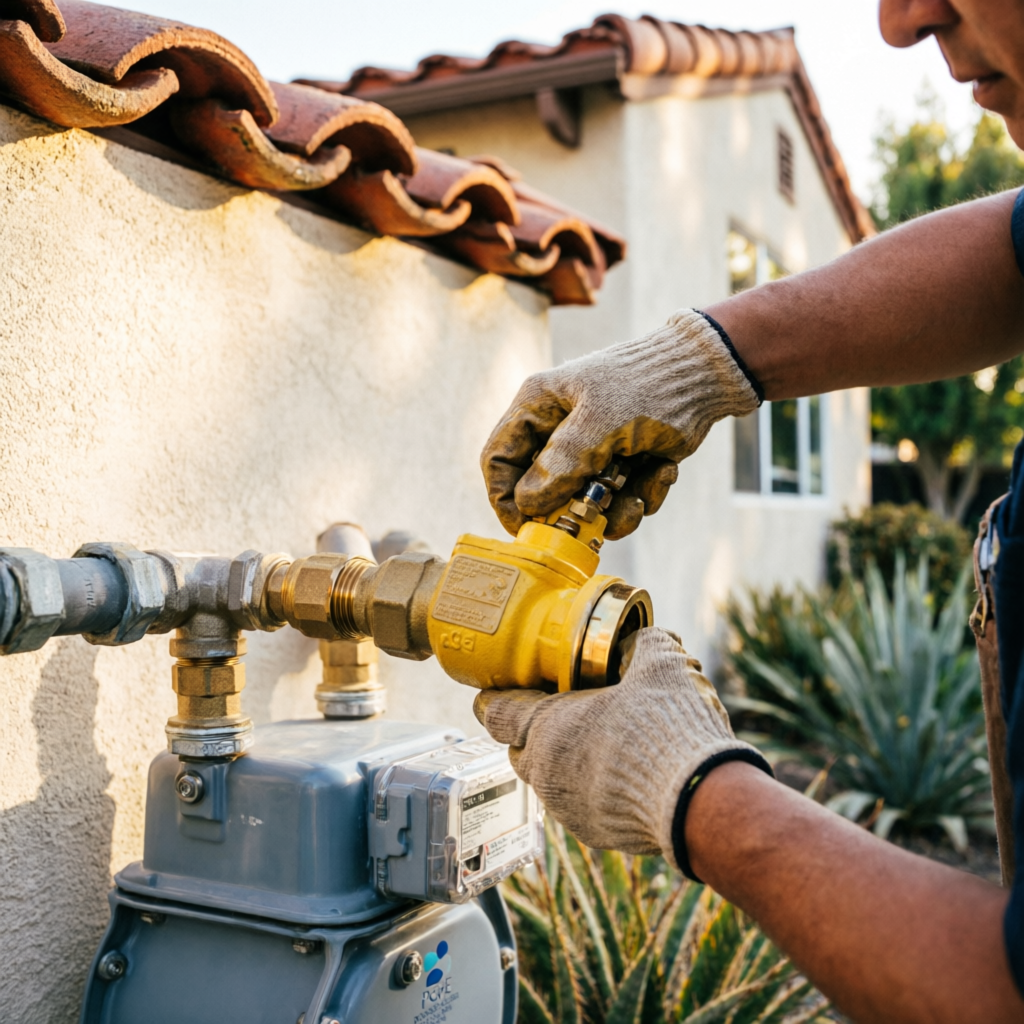
Walk outside any Los Angeles home built or sold after the late 1990s and look at the gas meter. Chances are you'll see a yellow or red metal box mounted on the incoming gas line — an earthquake gas shutoff valve. It's a small device, but in a 6.7 magnitude quake it's the single most important piece of plumbing on the property. It's also, in my experience, the single most misunderstood.
After 22 years and thousands of gas line service calls across LA, I've learned that most homeowners don't know if their valve works, don't know how to test it, don't know where the reset tool is, and — most dangerously — don't know when it's safe to turn the gas back on after a quake. Every major Southern California earthquake exposes the same pattern: people resetting valves without checking for leaks, gas explosions in damaged homes, and emergency crews spending their first critical hours on preventable fires instead of structural rescues.
This guide is the reference I wish every LA homeowner had taped inside their electrical panel. Read it, bookmark it, share it with whoever lives in your home. The next Big One won't wait for you to figure it out.
How earthquake gas valves actually work
An earthquake gas valve (also called a seismic shutoff, earthquake valve, or excess flow valve) is a mechanical device installed on the incoming gas line — usually between the utility meter and the house. Its job is simple: when ground shaking exceeds a preset threshold, the valve closes and stops gas flow into the building. No electricity, no batteries, no Wi-Fi, no app. Pure mechanical physics.
The mechanism
Inside the valve housing is a small stainless-steel ball resting in a cup on top of a precisely calibrated orifice. Under normal conditions, the ball sits in the cup and gas flows freely around it through the valve body.
When the ground shakes with enough force — typically a 5.4+ magnitude earthquake at the valve's location, or the equivalent ground acceleration — the ball is dislodged from its cup and rolls across the orifice, seating itself and blocking gas flow. The valve stays closed until it's manually reset with a tool.
The sensitivity is carefully calibrated. The valve should not trip from heavy trucks passing on the street, nearby construction, or minor 3.0 tremors that Southern California experiences weekly. It should trip from genuinely dangerous shaking that could damage gas lines, appliance connectors, or water heater gas valves inside the home.
Mechanical vs. electronic valves
There are two categories:
- Mechanical (ball-type) valves — the Pacific Valve, Seismic Safety Products (SPS), and LittleFire valves we install. Pure mechanical, no power required, zero maintenance between tests, 30+ year expected life. This is what LA code requires and what we install on 95% of our jobs.
- Electronic seismic valves — use accelerometers and solenoids. More sensitive, can log events, can integrate with home automation. Also more expensive, require power (with battery backup), and have more failure points. Specified in some high-value commercial and multi-family projects but rarely needed on single-family homes.
For 99% of LA homeowners, a mechanical ball-type valve is the right answer. It's code-compliant, maintenance-free, and costs a fraction of the electronic alternatives.
Who needs one — the LA code
Earthquake gas valves aren't optional in most of Los Angeles. The requirement comes from Los Angeles Ordinance 179721, enacted after the 1994 Northridge earthquake, which killed 57 people and caused billions in damage — much of it from gas-fed fires in homes with ruptured lines.
When an earthquake valve is required
Within the City of Los Angeles (and most surrounding municipalities that adopted similar code), an earthquake gas shutoff valve is required in the following situations:
- All new construction — single-family, multi-family, and commercial — with a gas service.
- Sale or transfer of most residential properties — the valve must be installed (or existing valve verified) before close of escrow. This is where most LA homeowners first encounter the requirement.
- New gas service installation on properties that previously had none.
- Gas line replacement or major modification.
- Multi-family and commercial buildings — stricter requirements, including annual inspection documentation for commercial properties.
Where the valve must be installed
LADBS code specifies that the valve must be on the customer side of the utility meter, upstream of any branch lines, and accessible for inspection and reset. Typically that means:
- On the exterior wall next to the gas meter
- Mounted vertically with the indicator window visible
- Between 12" and 60" above finished grade
- Unobstructed and not painted over (a surprisingly common problem)
Properties outside the City of Los Angeles (Santa Monica, Beverly Hills, Pasadena, Long Beach, Glendale, etc.) have their own building departments with slightly different requirements. Santa Monica and Pasadena, for example, require valves on all homes regardless of sale status. We handle permits and code nuances for every municipality we serve.
Three brands we install — and why
We've installed thousands of seismic valves across LA County over two decades. Three brands account for roughly 95% of our installations, and we spec them for specific reasons:
1. Pacific Valve (EQ series) — our default
Model we spec: Pacific Valve EQ-2 (¾") or EQ-1 (1")
Pacific Valve is the California market leader for a reason. Made in Santa Clarita, CSA-certified, LADBS-approved, and field-proven across hundreds of thousands of LA homes. The indicator window is visible from 20 feet. The reset tool is permanently tethered to the valve so you can't lose it. The ball mechanism has no springs or moving parts to corrode. We've never had a Pacific Valve fail to trip in a documented quake, and we've never had a false trip in 22 years of installations.
When we spec it: Default choice for single-family residential. 85% of our installs.
2. Seismic Safety Products (SPS-302) — the retrofit specialist
Model we spec: SPS-302 series
SPS valves have a slightly different internal design that handles dirty gas better — important in older LA neighborhoods where rust and scale in the main can contaminate the gas stream. They also have an excellent external wrench reset mechanism that's more intuitive than Pacific Valve's tethered tool, which matters in the chaos after a quake.
When we spec it: Homes with older gas mains (pre-1980s neighborhoods like Hollywood, Silver Lake, Echo Park), or when the homeowner prefers the external wrench reset.
3. LittleFire (by Safety First Products) — compact spaces
Model we spec: LittleFire LF-75
The LittleFire is physically smaller than Pacific Valve or SPS, which matters when the gas meter is tucked into a tight side yard or enclosed porch. It's also lighter, which helps on older stucco walls where a heavy valve would need extra mounting support.
When we spec it: Tight installations, side-yard meters, Spanish-style homes with enclosed entryways, and any job where the valve location has limited clearance.
We occasionally see homeowners who bought a "seismic valve" from Amazon or a big-box store. Many of these — particularly imported valves — are not LADBS-approved, not CSA-certified, and have no documented trip testing. Installing a non-certified valve won't pass LADBS inspection at sale time and won't protect your home in a real event. Every valve we install carries its certification sticker and serial number for the inspector to verify.
Annual testing — the 3-minute procedure
Earthquake valves are mechanical devices. Like any mechanical device, they can seize over time — particularly in LA's climate, where coastal salt air, inland dust, and years of neglect can gum up the moving parts. A valve that hasn't been tested in 10 years is a valve that might not trip when you need it to.
The good news: testing takes 3 minutes, requires no tools, and you can do it yourself.
Step-by-step annual test
- Pick a date. We recommend tying it to an existing annual event — smoke detector battery day (twice a year), the first day of earthquake preparedness month (April), or the anniversary of the Northridge quake (January 17).
- Tell everyone in the house you're about to shut off the gas. Pilot lights on the water heater, furnace, and stove will go out. Everyone needs to be clear that they shouldn't try to relight anything until you're done.
- Locate the reset tool. For Pacific Valve, it's the yellow plastic wrench tethered to the valve body. For SPS, it's the silver wrench on the side of the valve. For LittleFire, it's the attached flat-blade tool.
- Manually trip the valve. Insert the reset tool and turn it to the "CLOSED" position per the manufacturer's instructions. You'll hear/feel a click as the ball seats. The indicator window will change color (typically from green to red).
- Verify it tripped. Go to a gas appliance (stove is easiest) and try to light a burner. If the valve tripped correctly, no gas will flow and the burner won't light. If gas still flows, the valve has failed — call us immediately.
- Reset the valve. Turn the reset tool back to "OPEN." The indicator window returns to green. You may hear the ball drop back into its cup.
- Relight pilot lights. Water heater pilot, furnace pilot, and any standing-pilot appliances. Most modern appliances have electronic ignition and will self-relight. For standing-pilot units, follow the lighting instructions on the appliance's label.
- Verify all appliances work. Run the stove, confirm the water heater burner fires, check the furnace.
That's it. Three minutes, once a year, and you've verified the single most important safety device on your property works.
When to call a professional for testing
Most homeowners can do the annual test themselves. Call us if:
- You can't find the reset tool (common on older Pacific Valve installs where the tether broke)
- The valve won't manually trip (internal corrosion — the valve needs replacement)
- The valve trips but won't reset (ball stuck in the orifice — needs service)
- The valve trips and gas still flows (valve failed — emergency replacement)
- The valve is over 25 years old and has never been tested (we should inspect and likely replace)
- You're uncomfortable working on gas appliances
How to reset after an earthquake
If a real earthquake has tripped your valve, resetting it is the same mechanical action as the annual test — but the safety steps before the reset are critically different. Here's the sequence we teach every homeowner:
Step 1: Wait 10–15 minutes after shaking stops
Aftershocks are common in the minutes after a major quake. Don't rush to the gas valve immediately — you might reset it, then have a 5.0 aftershock trip it again, or worse, damage something while you're working on it.
Step 2: Check for gas smell BEFORE going near the valve
Before you walk to the meter, stand at your front door and sniff. If you smell natural gas (rotten eggs, sulfur, mercaptan odor):
- Don't approach the valve. Don't flip switches, don't use your phone, don't start the car.
- Evacuate the house with everyone and pets.
- Walk (don't drive) to a neighbor's house at least 300 feet away.
- Call 911, then SoCalGas at 1-800-427-2200.
- Call us once the utility clears the property.
A gas smell means there's a leak somewhere in your system — either the valve didn't trip, the valve failed, or a pipe/fitting/appliance connector inside the home ruptured. Resetting the valve in that scenario pumps gas into an already-leaking system and creates an explosion hazard.
Step 3: Walk the exterior of the house
If you don't smell gas, walk the full perimeter of your house and look for:
- Cracks in the foundation or stucco
- Separated gas line fittings at the meter, at appliance connections, or at wall penetrations
- A visibly bent or pulled-apart gas line
- Fallen water heater (common in quakes — the gas flex connector can tear if the tank moves too far)
- Downed power lines near gas equipment (don't approach)
If you see any of these, don't reset the valve. Call us first for a full gas line inspection.
Step 4: Walk the interior
Go inside and check:
- Water heater — is it still upright and connected? Is the gas flex line intact?
- Furnace — has it shifted off its platform? Is the gas connection secure?
- Stove and oven — have they moved? Are gas connectors tight?
- Gas fireplace — is the log set intact? Any cracks in the firebox?
- Gas dryer — is it still connected?
If any gas appliance has moved significantly, don't turn the gas back on. Have a licensed plumber inspect the appliance connectors first.
Step 5: Reset the valve
If all of the above checks pass — no gas smell, no visible damage, all appliances secure — you can reset the valve:
- Insert the reset tool
- Turn to "OPEN" position
- Confirm the indicator window returns to green
- Wait 2–3 minutes for gas pressure to equalize through the system
- Check for gas smell at the valve and at each appliance — if any smell appears, immediately shut off the valve and evacuate
- Relight pilot lights per manufacturer instructions
- Verify each gas appliance is firing normally
Step 6: Schedule a post-quake inspection
Even if everything seems fine, we recommend booking a professional gas line inspection within a week of any quake strong enough to trip your valve. Hidden damage — hairline cracks in appliance connectors, loosened fittings inside walls, stress fractures in gas flex lines — can leak slowly and undetectably for weeks before reaching dangerous concentration. Our post-quake gas inspection includes electronic leak detection at every appliance connection.
When NOT to reset — the five red flags
Resetting the valve when you shouldn't is how gas explosions happen. Do not reset your earthquake valve if any of these apply:
- Any smell of gas inside or outside the home, even faint.
- Visible damage to the gas meter, incoming gas line, or any appliance connector.
- Water heater has fallen or moved more than an inch from its original position.
- Structural damage to the home — major wall cracks, separated floors, shifted foundation.
- You're unsure. When in doubt, don't reset. Call a licensed plumber. The valve will stay closed indefinitely — there's no time pressure to reopen it.
Every year after a significant Southern California earthquake, we respond to at least one or two gas-related fires that started when homeowners reset their valves without checking for damage. The 1994 Northridge quake taught us this lesson the hard way — more than 100 post-quake fires were traced to premature gas restoration in damaged homes. Don't be one of them.
Insurance premium benefits
One of the most overlooked benefits of installing an earthquake gas valve is its impact on your homeowner's insurance. In California's earthquake-prone environment, carriers increasingly recognize that a properly installed seismic valve dramatically reduces fire risk after a quake — and many offer premium discounts accordingly.
Here's what we've documented from our customers' policies in the past year:
- California Earthquake Authority (CEA) policies — typically 5–10% premium reduction for verified seismic gas shutoff
- Major carriers (State Farm, Allstate, Farmers, Liberty Mutual) — variable, typically 3–8% on the dwelling fire coverage portion
- High-value homes — some Chubb and PURE underwriters require seismic valves as a condition of coverage
- Multi-family and commercial — often 10–15% premium reduction due to life-safety significance
To qualify, you typically need:
- A LADBS-approved, CSA-certified valve (the three brands above all qualify)
- Documentation of professional installation (we provide a certificate)
- Proof of final inspection sign-off (we handle this)
- For multi-family: annual inspection documentation
Call your agent after we install and ask about the "seismic gas shutoff" endorsement. Most carriers apply it immediately once we provide the install certificate.
The earthquake valve is the cheapest insurance policy you'll ever buy. It's a device that prevents a house fire. I've installed them on homes that shook through Northridge, Ridgecrest, and the 2019 Searles Valley quake — and every single one of them did exactly what they were built to do. Marcus Chen, Founder · Pacific Line Plumbing
Frequently asked questions
Most likely yes — if your home was built after 1998 or has been sold since the late 1990s, an earthquake valve is probably already installed. Walk outside to your gas meter and look for a yellow, red, or brass-colored box mounted on the incoming gas line between the utility meter and your house, typically 12"–60" above ground. It will have an indicator window (green = open, red = closed) and a reset tool tethered to it. If you don't see one, or your home is older and has never been sold since the mid-90s, you likely don't have one yet — and should consider installing one.
We strongly recommend against it. Installing a seismic valve requires working on the live gas line, which means either shutting off the gas at the utility curb stop (which requires coordination with SoCalGas) or working on a pressurized gas line — both of which are dangerous without proper training and equipment. A DIY install also won't pass LADBS inspection, which means it won't satisfy the legal requirement at sale time and won't qualify you for insurance discounts. Most importantly, an improperly installed valve can leak, fail to trip, or create a hazardous condition.
Most LADBS-approved mechanical valves are calibrated to trip at approximately 5.4 magnitude or greater, which corresponds to a peak ground acceleration (PGA) of about 0.15g to 0.20g. This is the threshold at which damage to gas lines, appliance connectors, and water heater flex lines becomes likely. The valve will not trip from minor tremors (3.0–4.5 magnitude), heavy trucks on nearby streets, or construction activity. After any quake strong enough to noticeably shake your home (typically 4.5+), it's worth checking the valve's indicator window — if it's still green, you're fine; if it's red, the valve did its job and needs to be reset after safety checks.
Not necessarily — but a valve that trips on minor shaking (under 5.0 magnitude) may be out of calibration. This can happen if the valve was dropped during installation, if the ball mechanism has picked up debris from the gas stream, or if the valve has aged past its recommended service life (typically 30 years). A technician can test the valve's trip sensitivity and either clean the mechanism, recalibrate if the brand allows it, or replace the valve if it's out of spec. We do this diagnostic on-site during a gas line inspection call.
No — that's one of the main benefits of owning your own seismic valve vs. relying on the utility to manage gas flow. You (or any competent household member) can reset the valve yourself once you've completed the safety checks in this guide. This is critical after a major quake: SoCalGas crews are typically overwhelmed with emergency calls for the first 24–72 hours after a significant event, and waiting for them to come reset your valve could leave you without hot water, cooking, or heating for days. Resetting it yourself — safely — gets your home back to normal in minutes.
Quality LADBS-approved mechanical valves (Pacific Valve, SPS, LittleFire) are designed to last 30+ years with proper annual testing. We've pulled Pacific Valves that were installed in the late 1990s and found them in perfect working condition after 25+ years — but only because the homeowners tested them annually. Valves that are never tested can seize up from corrosion, dust, and mineral deposits in the mechanism. Our recommendation: annual test for life, replacement at 30 years regardless of apparent condition, and immediate replacement if the valve fails any part of the annual test.
Yes, in most cases, but we recommend getting a replacement tool. Pacific Valve and SPS valves can be reset with a standard 7/16" wrench or crescent wrench in an emergency — but using the manufacturer's tool is safer because it's designed to apply torque in the correct direction and stop at the right point. We carry replacement reset tools on our trucks and can provide one during any service call, or you can order them directly from the manufacturer. In the meantime, tape a crescent wrench near the valve (in a weatherproof bag) so you have a backup.
No — if your home has no gas service at all (electric water heater, electric stove, electric furnace, no gas fireplace, no gas dryer, no gas line to the property), there's nothing to shut off and no earthquake valve is required. However, if you're planning to add any gas appliance in the future, or if you have a gas line capped off but still active at the meter, an earthquake valve is a smart installation. Some homeowners choose to have the gas line disconnected entirely at the meter by SoCalGas if they've fully electrified — this eliminates the risk and any code obligation.
Let's make sure your home is quake-ready.
Book a seismic valve install, test, or post-quake inspection with a licensed technician. We handle LADBS permits, inspection coordination, and insurance documentation.
Marcus Chen
Founder of Pacific Line Plumbing and a third-generation Los Angeles plumber with 22 years of field experience. Marcus has personally installed over 1,800 seismic gas shutoff valves across LA County — including hundreds of post-sale retrofits required by LADBS. He lives in a 1948 Silver Lake bungalow with a Pacific Valve EQ-2 on his own meter, tested every January 17.
Keep reading
Signs You Need Emergency Plumbing Repair — And When You Don't
Five warning signs that mean call now — including the gas smell scenario where evacuation, not a plumber, is the first step.
The Complete Guide to Slab Leak Detection in Los Angeles Homes
Post-war LA bungalows hide aging copper under concrete. Here's how electronic detection pinpoints leaks without demolition.
Galvanized Steel Pipes in LA: When to Repair vs. Repipe
If your Hollywood or Pasadena home was built before 1970, galvanized steel may still be in your walls — and its days are numbered.